Thought leadership
London Tech Week 2026: specificity and sovereignty

Kris Fields
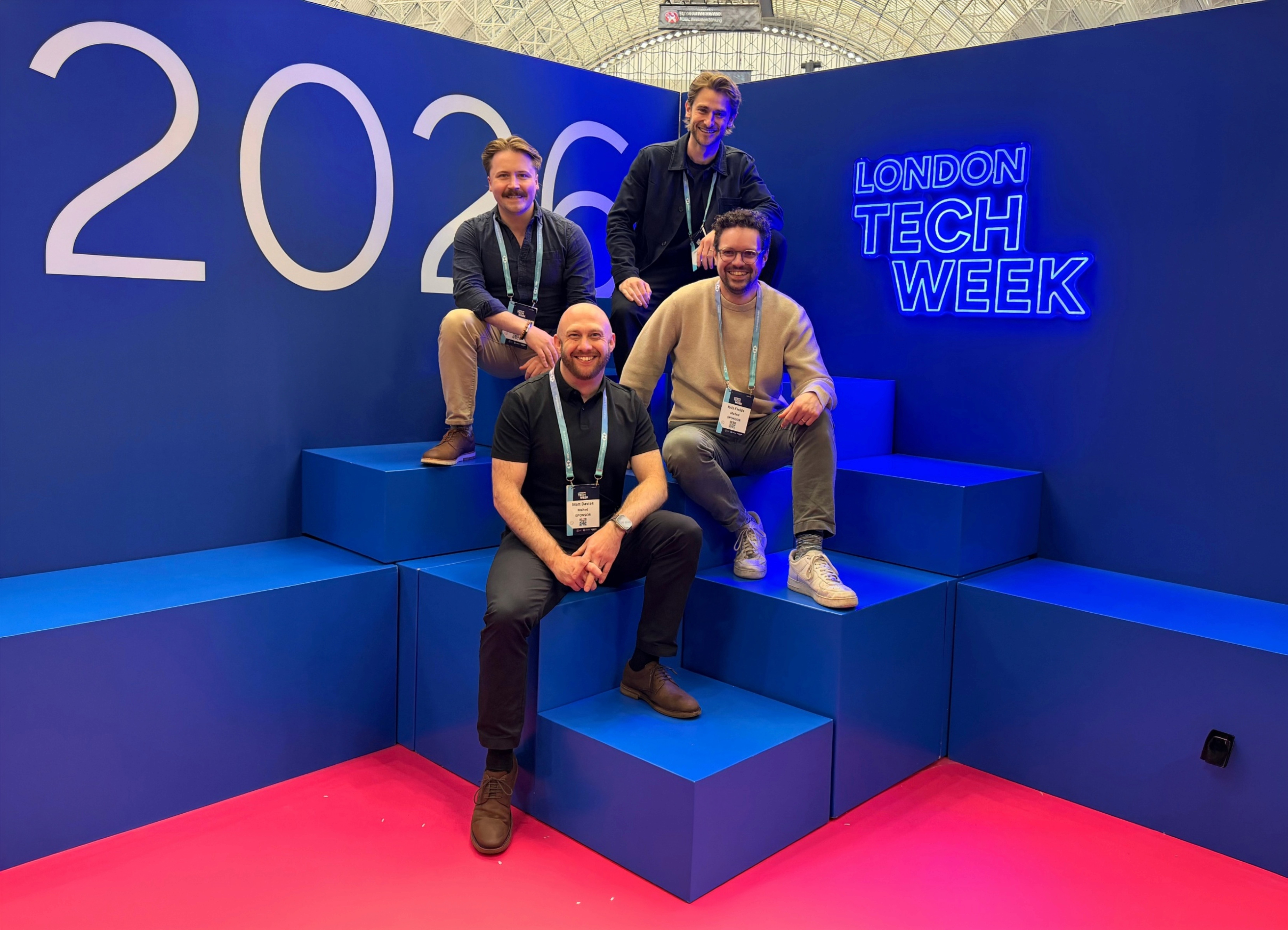
Last week four of us were at Kensington Olympia for London Tech Week, exhibiting on the Department for Business and Trade's UK showcase stand alongside 51 other companies working across AI, quantum, cyber, connectivity, engineering biology and semiconductors. We went to talk about Malted, and we did plenty of that. But the thing I keep coming back to, a few days on, is a pattern I noticed while wandering the stand between conversations: of the 25-odd AI companies exhibiting, almost none were building general-purpose models.

A hall full of specialists
Juro was there for contracts. CUBE for regulatory change, Intuety for risk in high-hazard industries, Quorso for retail operations, Wordsmith for in-house legal teams, Beam for frontline public services. And us, for financial services conversations. Wherever you turned, the pattern was the same: a team that had picked an industry, gone deep on its problems and built AI around the specific contours of those problems.
What struck me most was that nobody treated specialism as something to apologise for. Not long ago, "narrow" was almost a pejorative in AI circles – the interesting work was supposed to be happening inside the general-purpose labs, and applied companies were dismissed as wrappers waiting to be steamrolled by the next model release. That's not at all how it felt at Olympia. Specialism was the pitch, and depth of domain understanding was each company's moat.
The market data says the same thing, for what it's worth. Menlo Ventures put enterprise spending on vertical AI at $3.5bn in 2025, nearly triple the year before. But you didn't need a report to see it last week. You just needed to listen to the buyers walking the stand, who weren't asking "how big is your model?" so much as "does it understand my industry?"
And that question is really the whole point. The specialism on show wasn't a retreat from a frontier these companies couldn't reach, it was a response to what their customers actually want – which is almost always something that already understands their world. It's the same conviction that sits behind our approach to small, specialised models.
The phrase on everyone's lips
If one phrase dominated the conversations at Olympia this year, it was sovereign AI. It came up with government delegations, with investors, with founders – and there was no shortage of talks, panels and presentations on the topic. More interesting than the enthusiasm though, was the disagreement about what the term actually means.
At one extreme, sovereignty can be interpreted as complete nationalist self-sufficiency: every nation building the entire stack itself, from chips to data centres to frontier models. I didn't see anyone seriously argue for that version. Very few countries could replicate the frontier labs, the fabs and the hyperscale data centres end to end, and any that tried would likely bankrupt themselves in their attempt.
The consensus that emerged, at least in the conversations I was part of, was much more pragmatic. Sovereignty means owning enough of the stack – the parts that matter most to your economy and your security – that you command a seat at the table rather than taking whatever terms you're given. It's about leverage, not control, and tellingly that's increasingly how governments themselves are starting to describe it.
Sovereignty means owning enough of the stack that you command a seat at the table rather than taking whatever terms you're given.
Sovereignty lives at the application layer
On that definition, the strategy on display at London Tech Week looks more coherent than it might first appear. The billions that governments around the world are putting into compute and chips buy independence at the infrastructure layer, and that matters. But infrastructure is only half of the equation. The other half is capability at the application layer – the place where AI actually meets an economy and where the value lands. The 52 companies on the DBT stand were that half made visible.
Here's the angle that I didn't hear talked about much: application-layer AI sovereignty doesn't have to be nationalist. The moat for a vertical AI company is domain expertise rather than geography. A model built around contracts, or regulation, or financial services strengthens whichever organisation uses it, wherever it happens to be based. So a specialist can support sovereign capability in every market it serves – not by waving a flag, but by leaving the understanding of each institution's own operations where it belongs, with the institution, rather than letting it accrue to a general-purpose provider somewhere else.

Our own work is an example of the same thing. Malted's platform is built for financial services institutions, and the intelligence it surfaces – why customers get in touch, where the failure demand sits, what each friction point costs – stays with the institution rather than a general-purpose provider. That, I think, is what sovereignty comes down to once you shrink it from a national programme to a single organisation: not the compute or the model itself, but the understanding of your own customers, kept on your side.
The same conversation, viewed from different ends
By the time we packed the stand down on Wednesday evening, the two threads had wound together. The vertical thesis and the sovereign AI debate turn out to be essentially the same conversation: countries want to own the parts of the stack that matter, and the parts that matter most to an economy are the applied ones. The countries that get this right won't necessarily be the ones with the biggest models. They'll be the ones whose specialist companies end up embedded in industries everywhere.
If you'd like to see what that looks like in financial services, come and talk to us.